Table of Contents
1. Introduction
2. Lupita Nyong’o’s Story
3. The Make Fibroids Count Campaign
4. Women’s Health Research
5. Personal Challenges
6. Motherhood and Fibroids
7. Raising Awareness
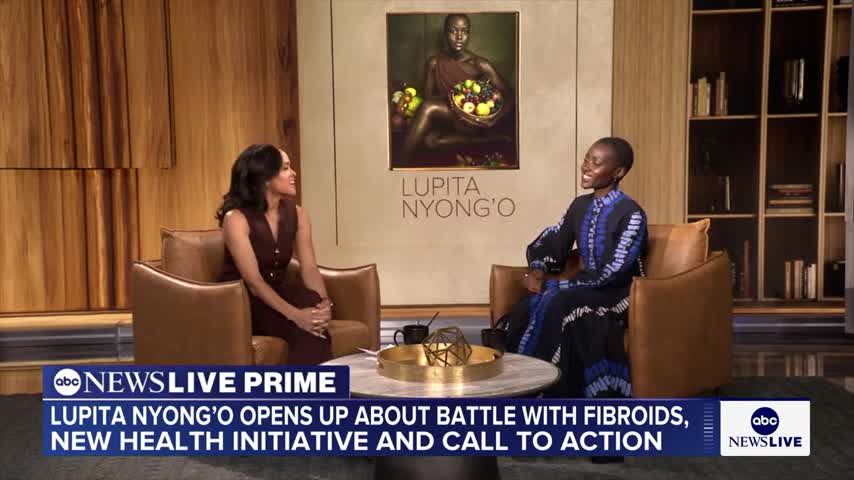
She’s an Oscar-winning actress who has wowed audiences for more than two decades. Now Lupita Nyong’o is sharing her own story, a health issue that many other women battle in silence. She lives with fibroids, and her experience has inspired a call to action. She’s now partnering with the Foundation for Women’s Health to start the Make Fibroids Count fundraising campaign. Lupita joined us earlier today to talk about her latest role advocating for women’s health. We want to welcome Lupita Nyong’o back to the show. Thank you so much for joining us once again. Thank you for having me. So you have spent your whole career telling stories, and I’m curious what it’s been like to tell your own so deeply personal story and share that with the world.
Well, when I first got diagnosed with fibroids in 2014, I chose to deal with it in private. Lupita Nyong’o. I just won an Academy Award, and my world was changing so fast in so many positive ways. Thank you so much for putting me in this position. And then I was also experiencing this threat to my reproductive health. I can’t believe this is real life. Ten years later, when I got re-diagnosed with fibroids, and this time with twice the amount, and I was offered the same options to deal with them, surgery or just live with the pain, I was actually quite angry and frustrated because I was like how is it that my experience of this disease has changed But the options given to me have it so I chose to go public with it I chose to join forces with the foundation for women health That is an organization that seeks to fill the gaps in research during the woman life cycle and make a difference So what does that partnership look like with the Foundation for Women’s Health? Women’s Health, first of all, public funding is very low.
10% is about 10% of NIH funding that goes to women’s health. And 0.03% of that goes to fibroids. So it’s a big issue. So what the Foundation for Women’s Health does, it looks at the lifespan of a woman and tries to fill in the gaps where it’s not necessarily trendy to support certain illnesses. Many women, I’m one of them included, we’ve described this as suffering in silence. And I’m curious what that silent time looked like for you. Well, yeah, that’s a really good question. it looked like shame.
In the beginning, I thought, what did I do wrong? You know, what didn’t I do? How did I not protect my body? How did I not serve my body that it has betrayed me in this way? I was hiding in plain sight because I was on these red carpets and prancing about and twirling and putting on a brave face and acting like everything was okay. But in my private moments, I was dealing with heavy periods and severe clotting. At one point I had a period for over 30 days, you know, and I was pre-anemic and I was experiencing fatigue.
I think as women we are conditioned from when we are in our adolescent years to expect pain to expect discomfort and we not taught how to observe our bodies Last time we talked it was six months ago you were on Capitol Hill advocating for more resources and research for women’s health. Any progress there? In this current budget, there is $15 million more being allocated to women’s research. So that is something to celebrate for sure. We need both the private sector with what I’m doing with the Make Fiberids Count campaign and the Foundation for Women’s Health. The private sector allows us to move faster, so we need the funding from both avenues, and this is why I have the Make Fiberids Count campaign, which everyone can participate in and donate to.
A few years ago, you said that you fantasized about motherhood. Is that still something that you think about and has your fibroid journey impacted that in any way? That’s a really real question you ask. And a lot of women face complications with their fertility because of fibroids, I’m no exception. There is no guarantee right now with surgery that that actually improves a woman’s chances of being able to carry a child. So it’s frustrating for me.
It’s been a real challenge And yes I still fantasize about motherhood There a lot that has to be in place for that to happen And I am definitely contending with the role my fibroids are playing in challenging that Can I ask the tears? Is it about the fibroids? Is it about motherhood? It’s about both. Oh, it’s about both. I have over 50. it’s flabbergasting that they’re growing so rapidly in my body. I cry because I desire something that I don’t know I’ll be able to have. When I saw this beautiful picture of you with the fruits, it made me think about because when I had fibroids, the doctor would say, you know, you have two grapefruits and you have an orange and they did them all in the size of fruits. Yes.
Is that the symbolism? That is exactly what the symbolism was because for me my largest fibroid right now is the size of an orange. I thought it was a really provocative image and also fruit is often used as a metaphor for fertility so there’s a double meaning in it and and so yeah so I thought I would bear the fruit we invisibly carry. I thank you for lifting your voice because you empowered me. I happened to see your post at the time when I was just about to have surgery and it gave me the courage to explain to so many people what I had been dealing with and countless people came forward to share similar stories. So I thank you for opening that door Lupita. Thank you for joining me in it. Thank you.
Leave a Reply