The Single Biggest Argument Against AI Stocks Just Died
Wall Street analysts have been warning for years: AI is a bubble, and the entire tech sector will crash as soon as spending slows down. But three major developments have just put an end to that argument and kicked off what could be the next phase of the AI era. As an electrical engineer and former AI researcher at MIT, I’ve never seen chip companies move this fast. Let me show you what’s going on and how I’m investing in it.
Table of Contents
1. The Single Biggest Argument Against AI Stocks Just Died
2. The Case Against AI—and Why It’s Crumbling
3. Why Spending Won’t Slow Down
3.1. AMD’s Bet: Hyper-Optimized, Swappable Chips
3.2. Cerebras’s Bet: Wafer-Sized Chips That Cut the Cables
3.3. Nvidia’s Bet: GPUs as an Asset Class
4. What This Means for Investors
Key Takeaways
- Wall Street’s biggest bear case against AI—that spending will inevitably slow—is collapsing as hyperscalers invest aggressively, even going free-cash-flow negative.
- Data center infrastructure is a zero-sum game; spending will shift to new bottlenecks like cooling, memory, and compute density.
- AMD’s answer to the “memory wall” is hyper-optimized, swappable chips via its Talus acquisition, dramatically cutting inference costs.
- Cerebras is eliminating network bottlenecks with wafer-scale chips, boasting massive performance obligations and revenue growth.
- Nvidia is turning GPUs into an asset class, partnering with financial giants to finance over half a trillion dollars in AI infrastructure.
The Case Against AI—and Why It’s Crumbling
The biggest bear case has always been that AI spending will eventually slow down, and when it does, every stock that lives or dies by that spending will go down with it. Hyperscalers like Google, Amazon, Microsoft, and Meta report their CapEx budgets every quarter, and every quarter those budgets have grown like crazy. AI spending has been compounding at over 60% per year since 2023, and it’s actually expected to accelerate.
These four companies are currently on course to spend over $700 billion on data centers this year alone, compared to $375 billion in 2025—a 90% year-over-year increase. And it’s coming at a huge cost. Amazon’s free cash flow went from $18 billion to negative $7.6 billion over the last 12 months. Yet just a few weeks ago, Amazon increased its 2026 CapEx budget from $200 billion to $220 billion due to memory chip prices.
That same week, Alphabet added $15 billion to its CapEx budget while reporting negative free cash flow for the first time since Google went public in 2004. Meta’s free cash flows are down 91%. You would think spending would slow once the biggest companies burn through all their cash—but instead, they’re borrowing money and issuing new shares. Amazon sold $37 billion in bonds in Q1. Alphabet issued over $65 billion in bonds this year and announced an $85 billion equity raise in June, the largest in American corporate history. Debt covered 9% of hyperscaler CapEx in 2024; today it covers 32%.

Why Spending Won’t Slow Down
It’s critical to understand why these companies keep investing at all costs. Data center infrastructure is a zero-sum game. There’s only so much land and grid-connected power. Every acre and gigawatt you don’t get is one your competition does. A new data center can wait two to six years for a grid connection. Even when land and power are bought up, spending will just shift to the next bottleneck: cooling, compute density, network and memory speeds. Every part of the AI stack is supply constrained.
So the question isn’t whether AI spending will slow down—it’s where it will shift next. Three of the biggest AI chip companies on earth—Nvidia, Cerebras, and AMD—all have very different answers.
AMD’s Bet: Hyper-Optimized, Swappable Chips
AMD’s answer is memory. An AI model is made of billions of numbers called parameters; each weight takes about 16 bits (2 bytes) of memory. A model with 400 billion parameters needs around 800 gigabytes of memory. A single Nvidia H200 GPU has 141 GB, so you’d need about six just to ask the model a single question. The processor spends most of its time waiting for data to arrive from memory—that wait time is the bottleneck.

On August 6th, AMD announced plans to acquire Talus, a chip startup founded in 2023 that etches AI model weights directly into the metal layers of a chip. This eliminates the need to load weights from memory, dramatically increasing throughput and reducing latency. Each chip is permanently dedicated to a single model, trading general-purpose programmability for maximum efficiency. If the acquisition goes through, AMD will combine these specialized chips with its own Instinct GPUs so GPUs handle dynamic workloads while the fixed-weight chips manage the memory-heavy decode phase of inference.
Talus’s chip destroys the “memory wall.” A typical cloud AI provider can serve LLaMA 3.18B at 140 tokens per second per user; the same model hits 17,000 tokens per second on the Talus chip—120 times faster. Responses appear instantly, not line by line. But how do you avoid obsolescence when chips take years to design? Talus uses a tiered manufacturing process: the chip is built in over 100 stacked layers. The bottom 98% never changes; only the top two metal layers translate a model-specific weight matrix into physical chip. TSMC can pull a base wafer off the shelf, add those two layers, and ship the chip within 60 days. Clusters can be swapped out every year when a new model drops. The chips are also cheaper: made on older 6nm technology, no high-bandwidth memory, simpler packaging. Talus claims their chips cost less than a penny per million tokens to run versus about 3 cents for Nvidia Blackwell. AMD is betting that spending will shift to ultra-low-cost chips that can be easily swapped as models improve.
Cerebras’s Bet: Wafer-Sized Chips That Cut the Cables
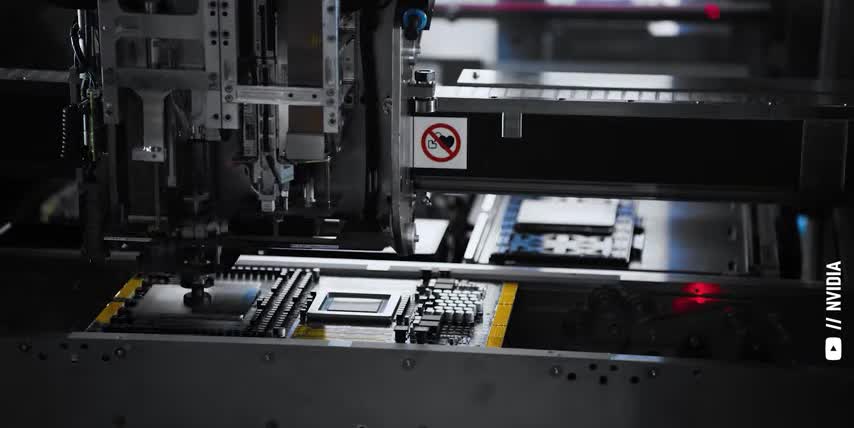
While AMD focuses on memory, Cerebras is cutting cables. A modern AI cluster has thousands of separate chips connected by network cables and switches. Every time data moves between chips, it costs time and power. Chips can spend more time waiting for data over the network than processing it. Cerebras never cuts the wafer; instead, they turn it into one massive chip called the Wafer Scale Engine (WSE). Their current WSE3 is about 8 inches on each side—30 times more area than Nvidia’s Blackwell B200. It has 4 trillion transistors, 900,000 cores, and 44 GB of SRAM (88 times more than Grok’s LPUs). Memory bandwidth is 21 petabytes per second—2,600 times that of Nvidia B200s. That means this chip can move Netflix’s entire uncompressed archive (about 4 PB) between cores five times every second. No hops, no cables, only compute.
Cerebras just reported earnings for the first time since going public. Remaining performance obligations hit $25.4 billion—a backlog worth 29 times their expected 2026 revenue of $880–890 million. They expect to deliver about 22% of that backlog in the next two years and another 43% in the two years after. Hardware revenue came in at $82 million (up 17% year-over-year, after adjusting for a $28 million stock warrant charge to OpenAI). Cloud and services revenue hit $127 million, up 287% year-over-year. The real money is in selling access to their machines, not the machines themselves. Cerebras is betting on wafer-sized chips that eliminate rack-level networking.
Nvidia’s Bet: GPUs as an Asset Class
Nvidia’s answer is to turn the chips themselves into investable assets. Nobody builds a skyscraper with cash; developers borrow because the building holds its value and can be sold if things go sideways. Nvidia wants AI data centers to work the same way. On August 10th, Nvidia announced deals with Apollo, BlackRock, Blackstone, Brookfield, Goldman Sachs, and KKR to build financing platforms for over half a trillion dollars of AI infrastructure. None of that money is Nvidia’s—it’s pension funds, sovereign wealth funds, insurers—the slowest, most conservative money on the planet.
Jensen Huang’s idea: a GPU makes good collateral because someone else will always want it, and Nvidia’s software updates extend its useful lifespan. For example, TensorRT-LLM doubled the inference performance of H100s overnight—for free. The software works on older Ampere and Ada Lovelace chips too. But there are three big catches: none of the deals are binding yet; Nvidia may cover up to 25% of losses if equipment depreciates below loan value; and loans can last longer than customer contracts. CoreWeave just closed a $2.6 billion loan against its GPUs that runs five years, while customer contracts only last three. If those GPUs aren’t rented again after three years, paying back the five-year loan could be problematic. The market still needs to answer: what is the actual useful lifespan of a GPU? Three years? Five? That determines whether GPUs are viable as an asset class. We may get an answer on August 26th when Nvidia reports earnings.
What This Means for Investors
The biggest argument against AI stocks has always been that spending will eventually slow down. But Amazon and Google both went free-cash-flow negative and raised capital to spend even more. The question is no longer if spending slows, but where it shifts next. Three of the biggest AI chip companies have three different answers: AMD bets on hyper-optimized, swappable chips; Cerebras bets on wafer-sized chips that eliminate networking; Nvidia bets that GPUs will become an asset class because someone will always want to rent them.
I expect AI spending to keep accelerating until the world runs out of land and power for data centers. After that, spending will just shift to filling them. Money is no longer the constraint. That’s why I believe investing in AI is still a great way to get rich without getting lucky. The best investment you can make is in yourself—and in understanding where the next wave of AI infrastructure dollars will flow.
CTA title 1
CTA Description Description Description Description Description
Leave a Reply